Unchecked corporate power is the single biggest threat to life on the planet, the driving force behind all the major crises we face.
Chris O’Connell, Advocacy Advisor Human Rights and Civil Society Space
Originally published by Trócaire
A range of expert reports point to the central role of corporations in enabling the Gaza genocide, causing and prolonging the climate crisis, incentivising and contributing to attacks on environmental and land defenders, alongside widespread pollution and biodiversity loss.
This brazenly unjust and inequitable situation cannot be allowed to continue. New approaches that fundamentally alter the calculus for corporate actors are required. Key among these is the proposal for a binding international treaty on business and human rights to create a level playing field on standards, close legal gaps that allow corporations to evade accountability, and provide access to justice for victims and affected communities. It is time for a treaty.
Trócaire participated in the Eleventh Session of the negotiations at the UN in Geneva in October alongside human rights partners and other civil society allies. Overall, the conduct and outcomes of the session offered hope of progress on curbing corporate power, hope that is much needed following the EU’s betrayal of its promises on this issue. Here are some of the key currents that arose during the session.
1. Global South back in force
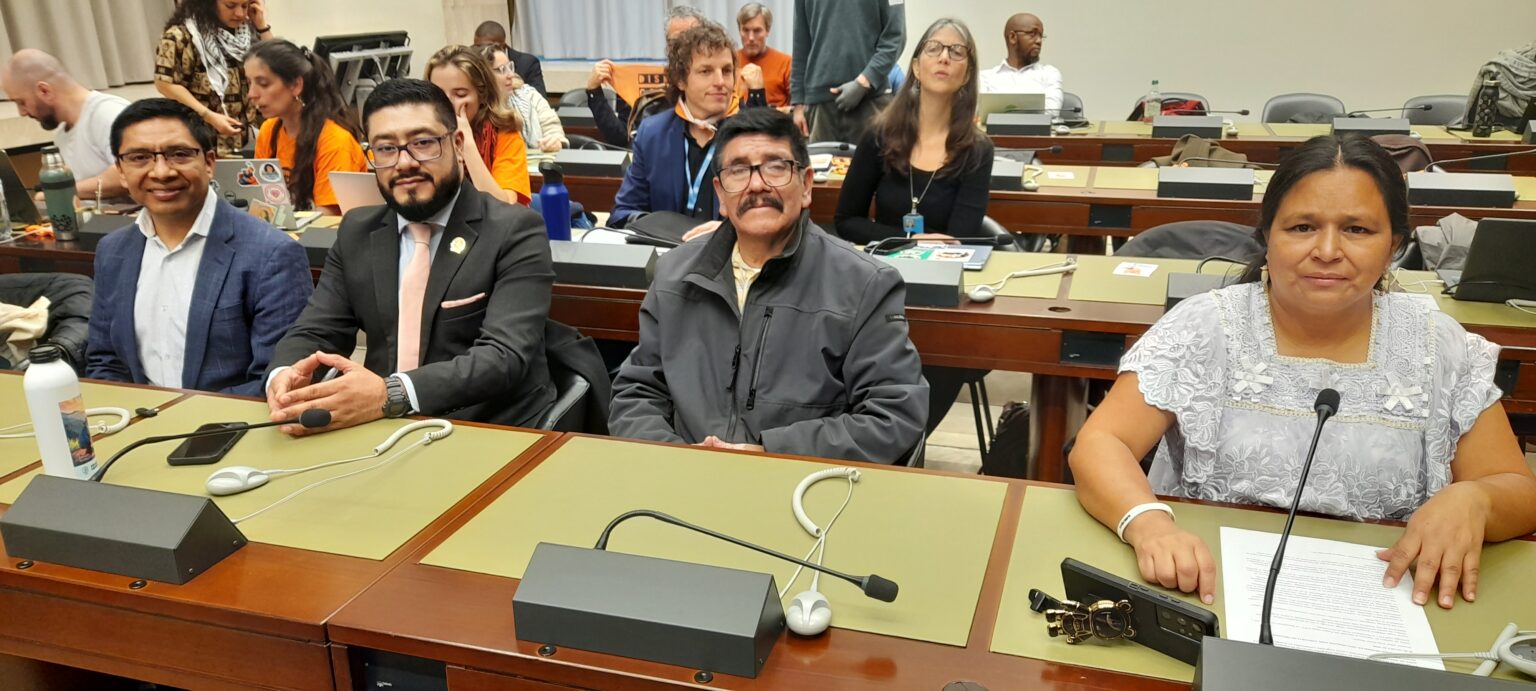
Voices from the Global South were largely absent from the treaty’s Tenth Session following the last-minute change of date in 2024. This year was different, with active mobilisation (including a protest against corporate complicity in the Gaza genocide) and impressive participation by Global South civil society. Those present included three of Trócaire’s Guatemalan human rights partners – the Xinka Parliament, the Council of Mayan Peoples (CPO) and the Pastoral Commission for Peace and Ecology (COPAE) – all of whom made important contributions.
The opening statement delivered by Ramona Margarita Domingo of CPO was particularly powerful, calling for respect for indigenous self-determination and for recognition of “the interdependence between human beings and Mother Earth”.
This call was echoed in the short but telling appeal for more focus on environmental protection by Vanuatu, in line with the recent ICJ advisory opinion on climate change.
Although the participation of Global South states was not as strong as at other sessions, longstanding progressive advocates Palestine, Ghana and Colombia were supported by Uruguay, Mexico and Mozambique.
While the absence of the US meant that a longstanding opponent of the treaty was missing, a grouping of Gulf States (Saudi Arabia, Kuwait, Qatar and the UAE) coordinated to advance a conservative, pro-business agenda.
2. The empty chair – where was Ireland?
For the eleventh time, the European Union failed to approve a negotiating mandate to formally participate in the treaty negotiations. In light of the dismantling of its own flagship human rights due diligence law and broader ‘bonfire’ of regulations in response to intensive corporate lobbying and US pressure, that is hardly surprising.
Nonetheless, the EU delegation and some member states like Germany made repeated oral contributions during the Session, while at least a dozen EU members were present throughout the week. In spite of calls by Trócaire and its partners at a special hearing of the Joint Oireachtas Committee on Foreign Affairs and Trade for Ireland to publicly signal its support for the treaty process, the state has adopted no public position and had no representatives at the Eleventh Session.
3. Human rights the priority
Quelvin Jimenez of the Xinka Parliament made a strong argument for putting international human rights obligations above trade and investment agreements in an intervention on Article 14.
Citing examples of mining companies bringing lawsuits against Guatemala under the Investor-State Dispute Settlement (ISDS) mechanisms established by those agreements, he outlined how poorer states are forced to choose between paying huge sums in compensation to large companies or permitting mining operations to go ahead, even when they violate indigenous rights or environmental laws.
To avoid traps like these, the treaty must clearly assert the primacy of human rights over trade and investment – a position supported by Mexico and Palestine but opposed by Gulf States.
4. Fears of corporate capture continue
A recurring concern with the treaty negotiations is corporate capture – a fear that has only grown in light of the concerted corporate campaign to kill the EU’s human rights due diligence law.
One aspect relates to the negotiations themselves: as previously highlighted, the active participation of business in an international legal process that was initiated as a response to the irresponsible and even illegal behaviour of business. This fundamental conflict of interest was once again highlighted by civil society during the 11th Session, including via a short protest in the negotiating chamber.
Another facet of corporate capture relates to the eventual implementation of the treaty. Article 16 currently includes text that seeks to protect national policies and decision-making from undue corporate influence. This provision was targeted for removal or weakening in a concerted attack led by Gulf States. If ultimately approved, this would allow transnational corporations to continue their ‘divide and conquer’ tactics toward poorer countries.
5. A hopeful path forward?
Following eleven years of slow and uneven progress, the treaty process is now advancing with unprecedented speed, galvanised by thematic consultations and participation by legal experts. The Eleventh Session saw the Chair build on this momentum by bringing together existing proposals and legal advice to suggest possible redrafts of key provisions.
While States and civil society will need time to scrutinise the suggestions and provide feedback, the document contained important elements such as joint and several liability for parent companies and subsidiaries, and more flexibility on jurisdiction for victims.
As the process moves forward with an ambitious roadmap for 2026, at long last there is hope for meaningful action to limit corporate power. In the words of Chair-Rapporteur Ambassador Marcelo Vázquez Bermúdez: “After more than a decade of work, the process has reached a decisive phase. We must translate momentum into lasting results.”