Chris O’Connell, Advocacy Advisor Human Rights and Civil Society Space
Originally published by Trócaire
On the 24th February last EU member states concluded possibly the most dramatic political U-turn in its history by voting through a version of its human rights due diligence law that is so weakened as to be almost unrecognisable. With vital protections now stripped out, the Corporate Sustainability Due Diligence Directive (CSDDD) represents a case study in corporate capture and the undermining of democracy.
What is CSDDD and why is it needed?
In July 2024 the original CSDDD was adopted following over a decade of debates, evidence-gathering and formal negotiations. The law responded in particular to shocking corporate abuses such as the Rana Plaza Disaster in 2013, the Brumadinho tailing dam collapse in 2019, the murder of Honduran defender Berta Cáceres in 2016, and thousands more. Along with helping to prevent other such abuses and providing a measure of justice for victims and their families, the directive also gave certainty to business, helped secure supply chains in the aftermath of Covid-19, and rewarded responsible business behaviour.
The directive contained key protections: a duty to carry out risk-based due diligence to identify, prevent or halt abuses; engagement with stakeholders, including unions and civil society; a harmonised approach to civil liability to reduce barriers for victims; and an obligation on big companies to implement climate transition plans to bring down emissions. While CSDDD was not perfect, it broke new ground and offered hope of positive change.
Then came the conservative corporate backlash and the EU’s betrayal of human rights defenders, workers and even its own values.
Killing CSDDD: The How, What and Why of the EU’s race to the bottom
Attempts by a nexus of corporations and conservative politicians to weaken the directive began even before it was adopted in 2024, as evidenced by the carving out of financial services from the due diligence duty after intensive lobbying led by BlackRock; and the reduction of the law’s scope to very large companies following interventions by key member states.
 Cerrejon mine in the La Guajira, northern Colombia, where Wayuu indigenous and Afro-descendant communities have been exposed to exploitation and the toxic effects of extraction for over three decades. Ireland’s ESB network has imported millions of tons of coal sourced from this notorious mine, associated with forced displacement and pollution. Photo: Steve Morgan / Greenpeace
But that was nothing compared to what followed the 2024 European elections. That was the starting pistol on a period of unprecedented corporate influencing that resulted not only in the EU abandoning commitments to preventing corporate human rights abuses and promoting responsible business, but also in the undermining its own values and democratic commitments. Here is the how, what and why of the EU’s torpedoing of its flagship human rights due diligence law.
How: The process employed was the previously little-known ‘Omnibus law’, designed to tweak to multiple laws at once. Since 2024, however, it has been used as a battering ram to knock down entire pieces of legislation, starting with CSDDD. Among the key democratic safeguards to fall under the wheels of the omnibus were impact and climate assessments (abandoned) and public consultations (replaced by a last-minute roundtable with hand-picked corporations). So skewed was the European Commission’s process that the European Ombudsman declared it ‘maladministration’. The oddities did not end there. At Council level the leaders of the EU’s most powerful states, German Chancellor Friedrich Merz and French President Emmanuel Macron, took the highly unusual step of issuing a joint call for the CSDDD to be scrapped altogether. New ground was also broken in the European Parliament with the European People’s Party (EPP), of which Fine Gael is a member, abandoning previous commitments in order to make common cause with anti-democratic far-right groups.
What: In terms of content, the Omnibus process undid almost all the key provisions of the original CSDDD, with those not deleted severely weakened. Specifically, the law:
- Deletes Climate Transition Plans, giving big business a licence to continue polluting;
- Removes the harmonised civil liability regime, making access to justice for victims and families far more difficult;
- Reduces the scope to only the very biggest companies (around 1,000, down from 7,000);
- Restricts the involvement of stakeholders, including trade unions and NGOs;
- Retains but limits companies’ duty to carry out risk-based due diligence.
Why: Why would the EU rip up its own flagship human rights due diligence law before it had even come into effect? And why would it breach its own rules and endanger democratic safeguards to do so? In short, there are three reasons:
- Corporate lobbying: An investigation by NGO SOMO revealed a sophisticated, multi-pronged lobbying campaign by a small number of transnational corporations, led by fossil fuel companies and their investors (ExxonMobil, Chevron, TotalEnergies, Koch) styling themselves the ‘Competitiveness Roundtable’. The campaign, coordinated by international consultants Teneo, targeted all three EU institutions, with tactics including dividing member states and pushing the EPP into alliance with the far right. So serious are the implications of this campaign that it was debated by the Dutch parliament in recent weeks. This is just the most high-profile example of business lobbying aimed at weakening CSDDD.
- Geopolitical pressure: Another strand of the Competitiveness Roundtable campaign was to mobilise support from third countries, specifically the US. In this they were also successful, with politicians condemning CSDDD and calling on companies to refuse to comply; the Trump government including CSDDD in the EU-US joint statement on trade; and the US and Qatar co-signing an open letter urging EU heads of state to repeal CSDDD.
- Europe’s rightward shift: There have also been internal pressures, with anti-system populists and mainstream centre-right forces finding common ground in their care for corporate profits. Under the guise of ‘competitiveness’ and ‘cutting red tape’ the EU has launched the biggest deregulation wave in its history, with at least nine other Omnibus laws planned, provisions to give big companies – including mega-polluters – privileged access to decision-makers, and plans for a so-called ‘28th Regime’. In the view of Executive Vice-President for a Clean, Just and Competitive Transition Teresa Ribera, these changes could spell the end of the EU.
What’s Next? Opposing Corporate Capture
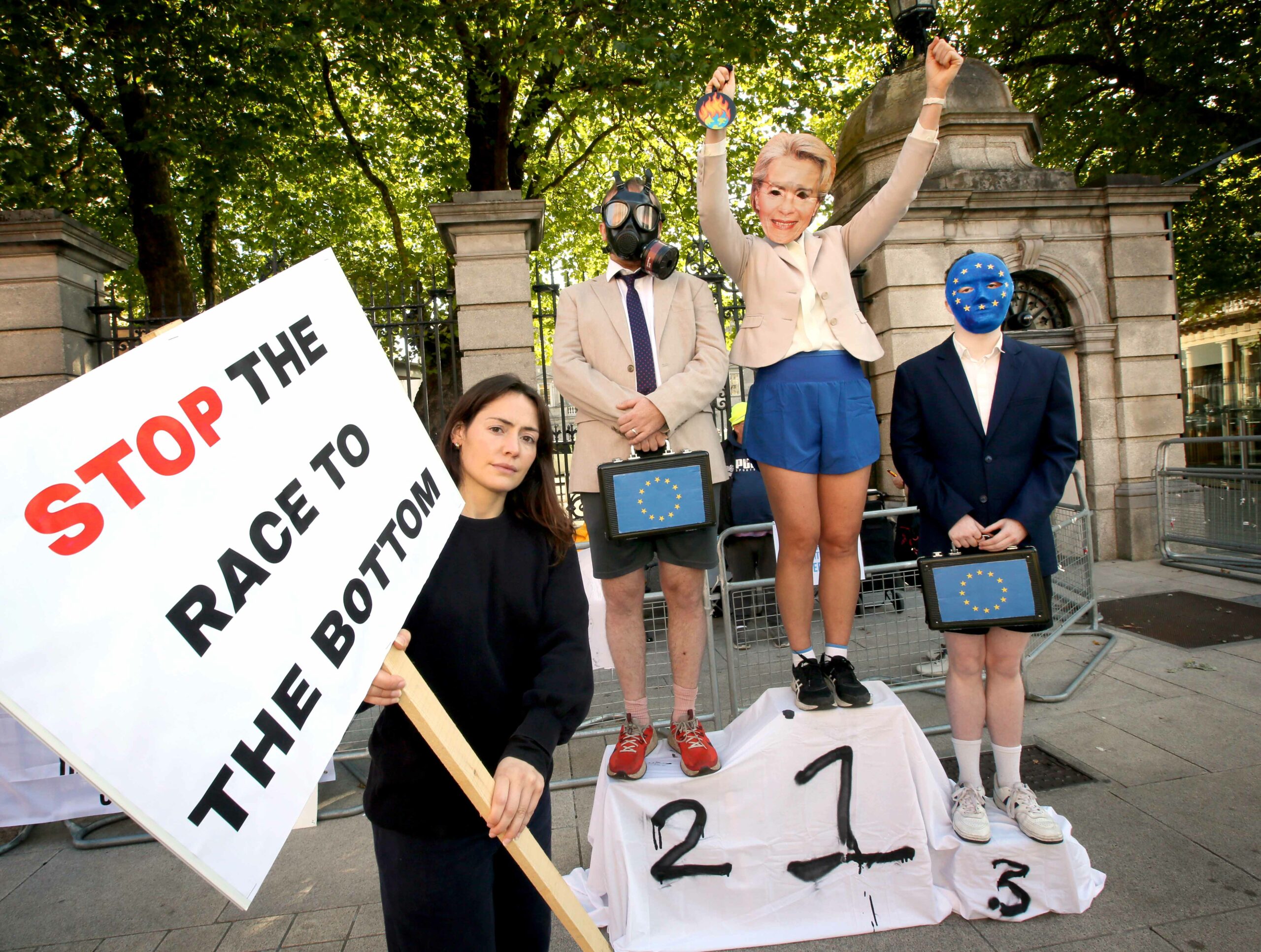
 People demonstrate outside of the Dáil in protest at the EU race to the bottom on corporate accountability, environmental protection and public interest. Photo: Mark Stedman
Regarding CSDDD, Ireland has until July 2028 to transpose the directive into national law. While the latitude to strengthen its provisions is limited, the government can still legislate to improve access to justice for victims and oblige companies to reduce emissions.
Trócaire, as part of the Irish Coalition for Business and Human Rights (ICBHR), will continue to advocate for strong laws to regulate corporate abuses, as well as to link with other organisations to defend democracy, civil society space and key environmental, health and labour protections – all of which are under threat – so that the interests of workers and communities everywhere take priority over profits for big corporations.