
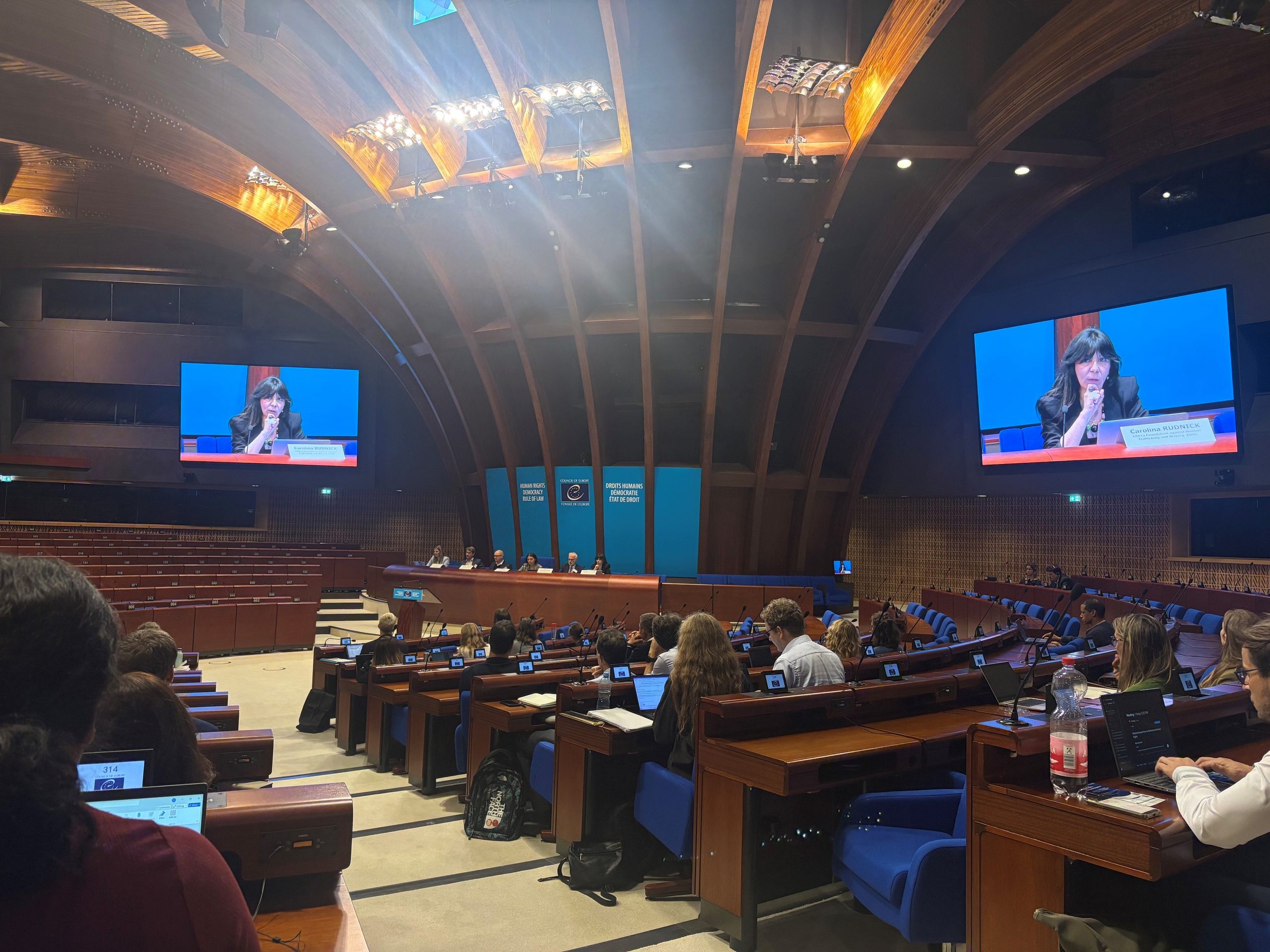
From September 17-18, 2026, the Irish Coalition for Business and Human Rights (ICBHR) joined civil society, legal experts, and trade unions at the inaugural regional Western Europe Forum on Business and Human Rights in Strasbourg. The Forum was centred around the theme, “Navigating the Challenges of our Time: Driving Action on Business and Human Rights” and was convened by the Danish Institute for Human rights, the European Coalition for Corporate Justice, the UN Global Compact, the NOVA Centre for Business, Human Rights and the Environment and the Council of Europe, in collaboration with the UN Working Group on Business and Human Rights.
Structural flaws and the dual crises of ecocide and forced labour
In the opening plenary session, Carolina Rudnick, Co-founder of Fundación Libera, an organisation that works to prevent and combat human trafficking, forced labour and modern slavery in Chile, Latin America and globally, made powerful remarks connecting the broken design of our global economy to the dual crises of ecocide and forced labour.
Recalling the calls to action from COP25 in Chile, Rudnick reminded the audience that environmental destruction and human trafficking are not isolated problems. They are twin symptoms of the same broken system. To fix this, she advocated for a fundamental shift away from GDP toward metrics that measure fundamental issues like rights, health, and environmental standards. Quoting André Gide, she reminded the audience that: “Everything that needs to be said has already been said; but since nobody was listening, everything must be said again.”
The standard for transposing the CSDDD in Ireland
At an ECCJ-organised panel, ICBHR Policy Coordinator Evie Clarke brought these global issues directly down to the Irish context. Transposition is not a neutral, technical exercise; the national choices made right now will determine whether this law actually protects workers and communities or becomes a paper-thin administrative exercise.
Meaningful stakeholder engagement is a necessary reality check on enforceability, yet Ireland faces severe structural obstacles. The Irish government supports the broader EU push toward minimum implementation, framing corporate accountability primarily as a “regulatory burden.”
An ICBHR-commissioned legal scoping study confirmed that the Irish Government is likely to transpose the CSDDD via secondary legislation, specifically a statutory instrument. While expedient, this route severely limits or completely removes parliamentary scrutiny and opportunities for amendment by civil society, trade unions, and rightsholders.
This risk is compounded by a broader structural trend in Ireland, where the state consistently fails to ensure meaningful civil society participation. Ireland currently ranks fourth-lowest of 38 OECD countries for stakeholder engagement in developing primary laws, and 113 Irish civil society organisations recently warned of a disproportionate corporate influence in policymaking.
To look at what a better approach looks like, we can look to other Member States building engagement directly into the policy drafting process, rather than treating it as a rubber-stamping exercise:
- Finland: Established a multi-stakeholder working group (civil society, trade unions, government, and business) that reviewed the Directive article by article and consulted external experts like the Sámi Parliament, even using the forum to correct errors in the translation of the text.
- Poland: Created a structured, ongoing working group that brought forward overlooked practical issues, such as the legal treatment of franchise arrangements.
- Spain: Provided consistent civil society access to government representatives at both technical and political levels alongside multi-stage public consultations.
The Irish government must be publicly challenged on how it plans to meaningfully transpose the directive and how it will fix the systemic exclusion of civil society. Ireland’s National Action Plan on Business and Human Rights was drawn up nearly a decade ago in 2017 and expired in 2020, signalling just how drastically the state has fallen behind on corporate accountability.
Ultimately, the government must ensure effective engagement with rightsholders and civil society because without their voices, the CSDDD becomes a tool that works only for corporations instead of the people it was intended to protect. True accountability means Ireland must actively reject a corporate-driven race to the bottom in favour of a legally binding, high-standard race to the top.
Confronting unchecked corporate power
A defining perspective of the forum came from Audrey Gaughran of the Centre for Research on Multinational Corporations (SOMO), who challenged the crowd to confront the sheer scale of current corporate influence.
Gaughran noted that while colonialism as a political project ended decades ago, colonialism as an economic project is ongoing. This is evident in the global architecture of the Investor-State Dispute Settlement (ISDS) system. Originally drafted and lobbied for by Shell’s legal department to protect corporate investments overseas, ISDS has grown into a parallel legal system. It allows multinational corporations to sue sovereign states in secretive tribunals, ensuring human rights abuses can happen with absolute impunity in certain countries but not in others.
For a country like Ireland, which maintains an extreme reliance on Foreign Direct Investment (FDI), there is a profound lack of understanding regarding how corporate power actually operates. Compliance remains entirely conditional; companies align with human rights only if it happens to suit their immediate business interests. Gaughran argued that while the UN Guiding Principles (UNGPs) are useful, trying to use them where they were never intended only entrenches systemic issues and urged a shift away from voluntary frameworks.
“Deep cleaning” and deregulation
This unchecked corporate power is directly driving the current pushback across Europe to weaken the CSDDD under the guise of “deregulation” and “competitiveness.”
Deregulation presents a profound threat to workers. Isabelle of the European Trade Union Confederation (ETUC) warned of an ongoing “deep cleaning” of existing regulations. Stripping away protections and weakening corporate accountability runs entirely counter to the European Agreement on Social Progress and actively harms workers.
Deregulation is a violation of the state duty to protect. Anita Ramasastry, Law Professor at the University of Washington School of Law in Seattle and former member of the UN Working Group on Business and Human Rights, stated clearly that when governments deregulate and strip away core protections for people and the environment, they are actively violating the State’s human rights obligations. Ramasastry challenged the corporate narrative on competitiveness, arguing it shouldn’t be a race to the bottom. True competitiveness means a race to the top, as seen with US forced labour regulations and the framework of the Green New Deal.
Deregulation is not what responsible business is asking for. Robert McCorquodale of the UN Working Group on Business and Human Rights marked 30 years of corporate accountability efforts by noting how much work remains, highlighting the group’s recent country visits to Serbia and Guatemala and reports on AI and finance. Crucially, McCorquodale debunked a common industry myth, stating that responsible businesses actually want clear, robust legislation.