
Understanding the UPR Process
On 10 November 2026, Ireland will undergo its next Universal Periodic Review (UPR). The UPR is a UN Human Rights Council process where member states evaluate each other’s human rights records roughly every four and a half years and provide recommendations on how they can be improved.
In the lead-up to this review, a pre-session takes place for national human rights institutions and civil society organisations to assess the State’s progress since its last cycle in 2021. This provides a vital opportunity to present the current domestic human rights situation directly to the UN diplomats who will be undertaking the upcoming evaluation.
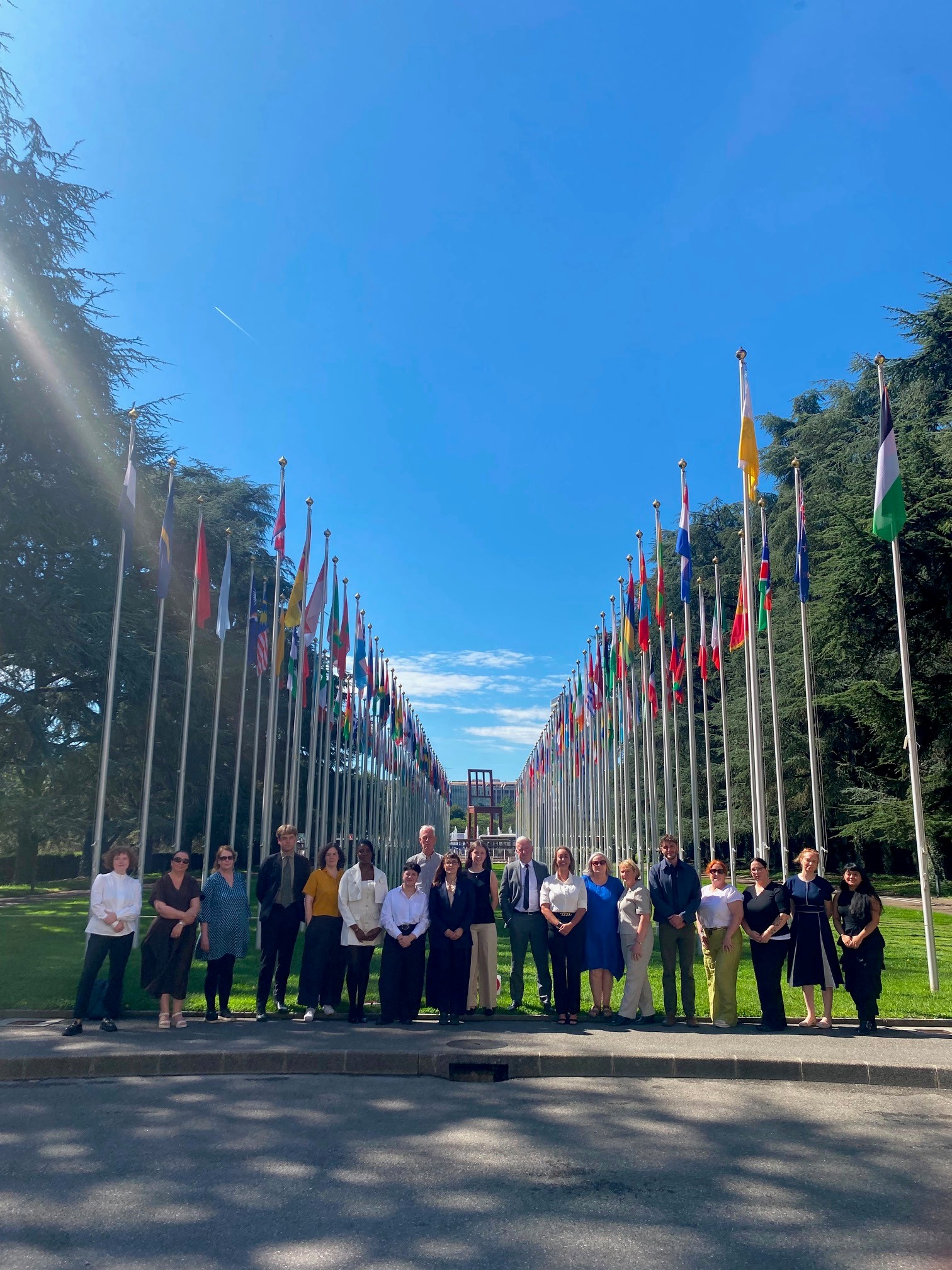
During this pre-session, the Irish Coalition for Business and Human Rights (ICBHR) stood alongside Irish civil society groups and statutory bodies including the Irish Human Rights and Equality Commission (IHREC), Plan International Ireland, Transgender Equality Network Ireland (TENI), Irish Network Against Racism (INAR), and Free Legal Advice Centres (FLAC) to hold the government to account.
Stagnation on corporate responsibility and accountability
When evaluating Ireland’s track record on business, human rights, and environmental protection, a troubling pattern of inaction emerges. During Ireland’s last UPR cycle in 2021, states including Palestine, Costa Rica, and the Bahamas made clear recommendations to the State. They urged Ireland to:
- Ensure Irish companies operating abroad do not impact human rights, particularly in conflict areas and situations of foreign occupation.
- Legally recognise the right to a clean, healthy, and sustainable environment.
- Embed human rights and environmental protections into its national trade and investment strategies.
Instead of building on these expectations, the Government is now supporting a wider deregulatory agenda. Often framed under the banner of “regulatory simplification,” this approach consistently prioritises short-term competitiveness and economic interests over human rights, environmental, and climate protections. This regression is highly visible in Ireland’s current trade policies, its push to ratify the Canada-EU trade agreement (CETA) with harmful provisions prioritising investor interests over the public interest, and its backing of EU-wide efforts to dilute corporate due diligence duties even when doing so weakens vital social and human rights safeguards.
The consequences of deregulation
This broader roll-back is already playing out at the EU level. A clear example is the recent weakening of the Corporate Sustainability Due Diligence Directive (CSDDD) through the Omnibus I framework, which narrowed due diligence mandates, limited value-chain coverage, gutted civil liability provisions, and removed the strict climate transition plan requirement. Ireland must not treat these weakened European standards as a ceiling for human rights protection and climate action.
The profound dangers of placing economic priorities above environmental safety were recently highlighted by the UN Special Rapporteur on the human right to a clean, healthy, and sustainable environment during her official visit to Ireland. She issued a stark warning that Ireland’s environmental progress is actively jeopardised whenever development goals are pursued without adequate climate impact considerations.
Furthermore, prominent UN treaty bodies including the Committee on Economic, Social and Cultural Rights , the Committee on the Rights of the Child and the Committee on the Elimination of Discrimination against Women have raised consistent concerns regarding Ireland’s approach to business and human rights. They have continuously pointed to the total absence of a second National Action Plan and the lack of comprehensive mandatory human rights and environmental due diligence (MHRDD) legislation.
To date, Ireland has failed to establish a comprehensive framework for corporate accountability or access to remedy. Affected communities are left entirely without adequate avenues for redress, while the State’s initial National Action Plan has remained expired since 2020 with no successor plan in sight.
Reduced civil society space and increased corporate influence
Genuine public participation is indispensable and ensures that state policies mirror the voices of those most affected while keeping government decisions under public scrutiny.
Unfortunately, Ireland continues to fail on civil society inclusion, currently ranking fourth-lowest out of 38 OECD countries for stakeholder engagement when developing primary laws. Reflecting this closed-door culture, 113 Irish civil society organisations have signed a joint warning exposing growing exclusion and the disproportionate, undue influence of corporate interests in national policymaking.
To combat this trend, the ICBHR prepared an advocacy factsheet detailing previous UPR cycles, charting the State’s lack of progress, and establishing a clear path forward for international diplomats.
Recommendations
- Adopt and enforce, by July 2028, comprehensive mandatory human rights and environmental due diligence legislation covering the full value chains of Irish companies, including overseas operations, with effective civil liability and access to remedy for affected individuals and communities. Ensure that transposition of the EU’s Corporate Sustainability Due Diligence Directive does not establish a ceiling for national protections and that Ireland strengthens protections beyond EU minimum requirements.
- Adopt a second National Action Plan on Business and Human Rights that sets out concrete, time-bound and measurable commitments to introduce mandatory human rights and environmental due diligence covering companies’ full value chains, with civil liability and effective access to justice, require climate transition plans, and ensure meaningful engagement with affected rights-holders and civil society.
- Recognise in law the right to a clean, healthy and sustainable environment and ensure that this right is reflected across legislation and government decision-making, including economic, trade, development and climate policy, with effective mechanisms for accountability and access to justice where environmental rights are violated.
- Guarantee meaningful, timely and inclusive participation of civil society, trade unions and affected communities in policymaking, including through greater transparency around government engagement with business interests and safeguards against undue corporate influence.
- Safeguard Ireland’s ability to regulate in the public interest in trade and investment policy by refraining from ratifying agreements containing investor-state dispute settlement mechanisms and reviewing existing agreements with a view to withdrawing from or terminating provisions that allow investors to challenge legitimate measures taken to protect human rights, the environment, public health or the climate.